Corfu, Greece
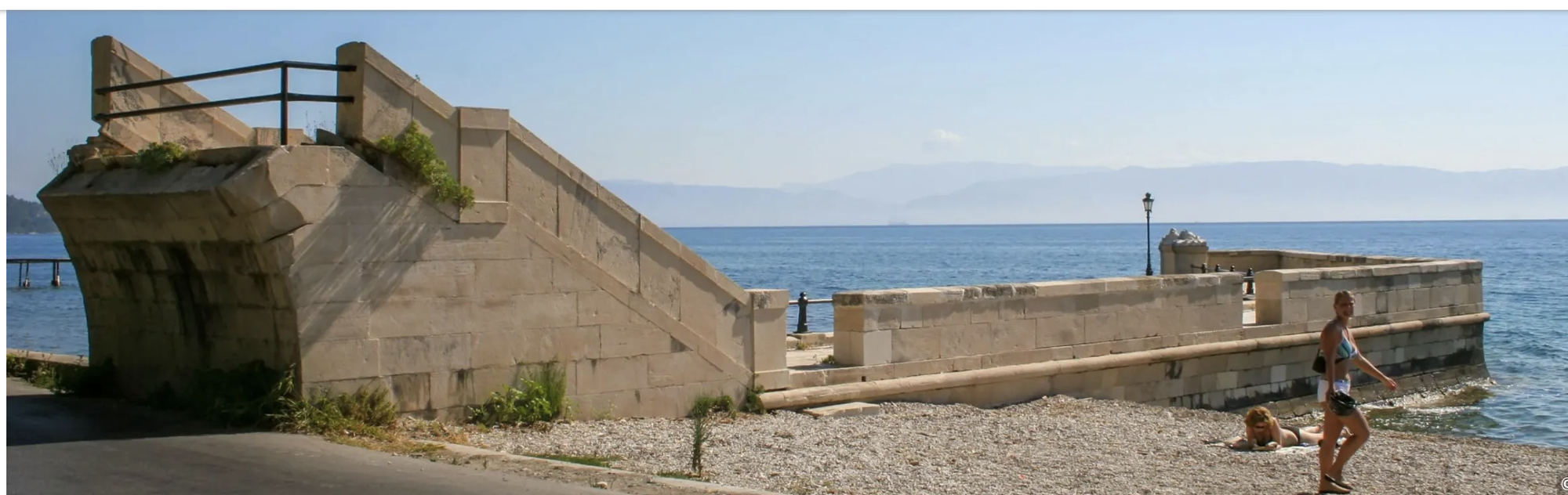
Corfu, Greece, is Greece's northernmost island. It is a popular tourist destination, especially for northern Europeans. It lies opposite Albania in the Aegean Sea. Greek food is legendary. The secluded beaches and verdant mountains are beautiful. What's not to like? Only the over-crowded airport. Corfu, Greece Corfu is the northernmost Greek island, located just off the coast opposite Albania. It’s a rocky mountainous island with a limited number of sandy beaches. Because of its warm Mediterranean climate, Corfu is very popular with Northern Europeans. Its capital city is dominated by two large fortresses built during the Venetian period of Corfu’s history. The Venetian fortresses were built to oppose the forces of the Ottoman Empire. The Ottomans laid siege to the Corfu fortresses three times over a period of many years. But the Ottomans were never successful in conquering Corfu. Corfu was the chosen site for our annual Kieler Old Farts Reunion , of friends who met each other while studying in Kiel, Germany, in the early seventies. We’ve been having these reunions for at least twenty years, meeting in the US, Germany, Norway, Italy, and Greece. Two of our members have died. Others are suffering from various negative health conditions. We had hoped for 8-10 attendees, but ultimately we were only five. Our small group led to more personal and intimate discussions than we might have had if we had been a larger group. Susan and I have traveled for adventure in in extended trips for several years. But this trip was only two weeks, one week in Sweden (See my blog: Stockholm—Pearl of Scandinavia ), and one week in Corfu, Greece. We Kielers had chosen Corfu so that our friend David could attend. David, a retired US physician (whom I met in 1969 in Kiel), immigrated to Greece several years ago. Susan and I have visited David twice before at his home on the mainland, the Peloponnese peninsula of Greece. Unfortunately, David had a medical condition that prevented him from attending this year’s reunion. At the end of our week in Corfu, we decided that Greece is our favorite reunion destination, and that we might meet here again sometime next year for our next reunion. I feared that this year’s reunion could be our final one, due to the diminished size of our original circle of friends. Who attended this year’s Kieler Old Farts Reunion The organizer of our reunion was my Norwegian friend Per. I first met Per in Kiel in 1972. In the intervening years, Per has become a ”captain of industry.” He is a serial entrepreneur, having started fifty(!) companies in his career as an alternative energy expert. His most successful companies install and run windmills. Germany is the world leader in the amount of wind energy generated, mostly due to the prevailing winds blowing off the North Sea. Per also holds the European patent to a unique biomass conversion technology. This technology is portable in a tractor-trailer, able to go on location and collect leaves and other forms of biomass, converting them into pellets to be burned in furnaces, replacing conventional oil furnaces. He has a model factory near Kiel which is expanding to accommodate his growing business to fulfill the demand for clean energy, and to replace petroleum imports. Germany has no oil reserves of its own, meaning that it has to spend billions on petroleum imports, mostly from Russia. This circumstance, particularly with the world boycott of Russian oil, stimulates all forms of renewable and alternative energy. Per is riding that demand wave very successfully. Per has lived in Kiel, Germany for decades and is married to a German woman. The other two attendees were a couple from Las Vegas. Ed was accompanied by his Mexican-born partner Norma. I met Ed in Kiel back in 1969. It’s notable that even though I’ve known Per and Ed for over fifty years, we had more personal time with each other than ever before. We talked about old times and the people we knew fifty years ago. We are still in touch with some friends from that time who have never attended a Kieler Old Farts reunion, except for our one reunion in Kiel in 2013. So there was a lot of reminiscing. Corfu: a Popular Tourist Destination Arriving at the Corfu airport was a stressful experience. Six planes had arrived at the same time, but there were only three baggage carousels in the arrival hall. Susan was stressed because our Ryan Air check-in official had prohibited Susan from carrying on her small travel harp, as she had done on countless other flights. The travel harp had received “special handling” at check-in, but it was simply sent onto the baggage carousel in Corfu. Luckily, the small harp received only minor damage. Per, being the most experienced of us in the area, chose a wonderful older hotel, called the Kaiser Bridge . The original Kaiser Bridge (See the photo in the accompanying gallery) was built to convey the residents of the Achillione Palace from a path to walk to the ocean without having to take the common road. The Kaiser Bridge was destroyed by the Nazis during their WWII occupation, in order to facilitate the movement of German military vehicles along the coastal road. Queen Elizabeth of Austria , known as “ Sissi, ” designed and built the Achillione Palace to glorify Greek culture. She collected and installed a large number of statues, dominated by a towering Achilles statue overlooking the Corfu landscape. It was completed in 1891. Sissi was assassinated in Switzerland by an Italian anarchist. After her death the palace was uninhabited for nine years, followed over the years by a casino, a museum, a school, and a military facility, under various owners. Today the interior is under reconstruction, so my photos are limited to the garden surrounding the palace. The Kaiser Bridge Hotel is owned and managed by a family, three brothers and two cousins. The “family feel” was a nice atmosphere, which allowed us to get to know the whole family. The restaurant was good. The hotel had its own beach (although it was rocky, not sandy). It was a very comfortable place to stay, with the exception of the lack of parking places. I even scraped a vehicle in a close parking area. Ed had a career as a professional auto repair guy. He knew what to buy to remove the red paint from the vehicle I scraped in the hotel’s crowded parking. Luckily, Ed did a great job of removing it, without which I could have been charged a hefty repair fee by the rental company. Touring Corfu We spent several days driving to different parts of the island. During a previous visit as part of our Viking World Cruise several years ago, Susan and I had visited this historic monastery. It was nice visiting it for a second time on one of our day trips. The Greek Orthodox religion is a counterpart to the Italian Catholic church. The Greeks had their own pope at some point in opposition to the Roman Catholic pope. Now, the high priests of the Greek church have long beards and wear huge hats with their elaborate historic costumes. Their traditional costumes are a relic of the earlier historical period when the church was very rich and the common people were very poor. Per always rents a convertible sports car when attending our reunions. This year he rented an English Mini convertible. He would lead us on our daily road trips around the island. In attempting to avoid the congested traffic on the main roads, Per would lead us through narrow back roads in the directions that we wanted to go. My rental car was a Citroen, which was bigger than Per’s Mini. Some of the back streets, narrow roads between old buildings, were scarcely wide enough for my Citroen to pass. Also, only manual transmission autos were available for rent. I grew up driving cars with manual transmissions, but I hadn’t driven so much with one for many years. We visited several beaches where we swam, followed by delicious meals in the seaside tavernas. Greece has its own native wines as well as renowned liquors, Ouzo and Retsina. Greece’s Mythos beer is also very good. Albania Corfu and Albania face each other across a narrow channel. Ferries carry tourists back and forth from Corfu several times a day. Albania is perhaps the least-developed country for tourism in all of Europe. For many years Albania was the poorest country in Europe. Prices are half the costs in Corfu. This makes Albania attractive for tourists. The Albanian landscape is very mountainous, so the tourist industry is promoting the country’s undisturbed natural attractions for adventure tourists. For many years, Albania was completely shut off from the rest of the world, due to its decades-long tyrannical dictator Enver Hoxha . Hoxha was a Muslim Marxist-Leninist in the style of Stalin. Hoxha ruled Albania for decades as a brutal dictator, executing political opponents and anti-communists without trials. Hoxha shut Albania off from the rest of the world, telling Albanians that other countries were threatening to invade Albania. Thus Albania should prepare to defend itself by cutting off ties to other countries. There was also an elaborate fence and warning system along the coast to prevent Albanians from fleeing their country. The period of enforced isolation followed years of close communist relationships, first with the USSR, and after Stalin’s death a close relationship with China. Hoxha declared Albania to be the first atheist country in the world. Albania’s perhaps most famous native was the famous catholic nun, Mother Theresa, who became famous for her work in India. But dictator Hoxha did not allow Mother Theresa to visit her mother in Albania, calling her an agent of a foreign power. The paragraphs above are a very brief account of Albania’s unique history. My primary source was the extended essay about Enver Hoxha in Wikipedia. Readers who desire more information should check out Wikipedia’s excellent detailed account of Albanian history dominated by Hoxha’s long rule. We five Kielers took the fast hydrofoil ferry boat from Corfu to the Albanian city of Saranda . It was a modern city with mostly new construction. We saw one remnant of the Hoxha regime, a concrete machine gun nest. Supposedly thousands of them lined the coast during the Huhxa regime. Saranda’s lovely sandy beach is lined with open-air cafes similar to more familiar ones. In fact, many of them blared American music for their Guests. One other interesting observation is that there are absolutely no single-family dwellings! There are only multi-story apartment buildings. I assume that this is a tradition from the Hoxha period, when the government created housing for all, since there were no or few individuals or families rich enough to build a single-family house. Prices for food and drinks were just over half the prevailing prices in Corfu. Thus Saranda hosts many day-trippers from Corfu. The ferries were sold out. The fast hydrofoil ferry takes half an hour to sail from Corfu. We returned on the slower larger conventional ferry, which took ninety minutes to sail back to Corfu. Some tourists we met on the ferry were planning to stay for days or weeks in Albania. I sat next to a lady from Ireland. She was one of a twelve-member Irish group, none of whom knew each other before this tour. They were planning to tour for ten days around Albania, including a visit to the capital city, Tirana . The capital hosts Albania’s only airport with service from Lufthansa and Aegean Airlines. Nature tourists explore the relatively undeveloped interior of Albania. For decades, Albania has been listed as Europe’s poorest country. Please check out the photo gallery accompanying this blog. Click on individual photos to enlarge them and read the brief captions.